Signs of Creator Burnout You Might Be Ignoring
Burnout doesn't arrive with a fanfare. It creeps in quietly — first as a slight reluctance to open your notes app, then as dread when Sunday rolls around and you haven't prepared the week's content. By the time most creators recognize it, they've already been running on empty for months.
The classic signs include: dreading the platform you once loved, posting out of guilt rather than intention, feeling creatively blank even when you have time, and noticing that your engagement has dropped because your energy isn't behind the content anymore.
If any of those resonate, this article is for you. Not with a pep talk — but with an honest look at why the system most creators are using is fundamentally broken, and what you can replace it with.
"Burnout isn't a willpower problem. It's a systems problem. And you can't solve a systems problem by trying harder."
Why Most Advice Makes It Worse
The typical advice for burnout goes something like: take a break, come back refreshed, practice self-care. While none of this is wrong, it misses the root cause entirely. When you come back from a "break," the same system is waiting for you — the same undefined posting schedule, the same scramble to come up with ideas each week, the same lack of structure.
Breaks treat the symptom. What you need is to fix the engine.
Most creators operate on what I call the "reactive model" — they sit down to create when they feel like it, produce whatever comes to mind, and post whenever it's ready. This model is unsustainable because it ties creation to mood, and moods are unreliable. It treats every post as a new problem to solve rather than an execution of a pre-made plan.
The Sustainable Posting Approach
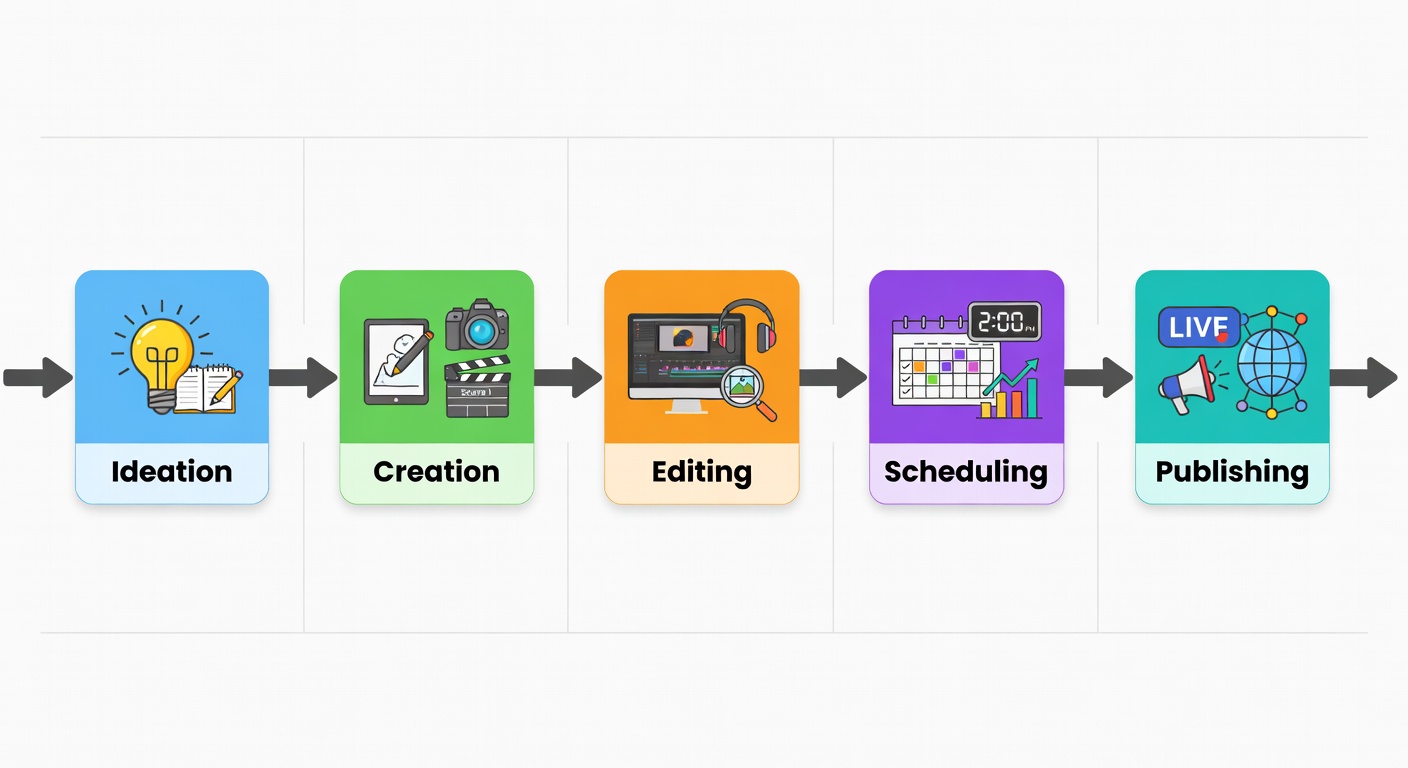
The sustainable alternative isn't about posting less — though that may be part of it. It's about decoupling the act of thinking from the act of producing, and the act of producing from the act of publishing.
Here's what that looks like in practice:
- Idea capture is always on. You never sit down to "brainstorm ideas." You capture them as they come, in a dedicated vault, and schedule separate time to process them.
- Planning happens in advance. At the start of each month, you decide what gets posted. During the month, you execute. Decision fatigue is eliminated.
- Production is batched. Rather than creating one piece at a time, you produce content in concentrated sessions — often clearing a week or more in a single afternoon.
- Publishing is automated. Your scheduler handles delivery. You don't need to be present every time something goes live.
The result is that no single day feels heavy. And because the plan already exists, you spend zero mental energy deciding what to create — just executing what you've already decided.
Content Batching as a Solution
Of all the tools available to creators fighting burnout, batching is the most underused and highest-leverage. The idea is simple: instead of creating one piece of content per day, you dedicate specific sessions to creating many pieces at once.
A typical batch session might look like this: on a Sunday afternoon, you block three hours. You have a list of 8 topics already prepared (from your idea vault). You write, record, or design all 8 back to back — staying in "creator mode" rather than constantly switching mental states.
The research on this is clear: context switching is expensive. Every time you stop doing one type of task and start another, your brain spends time recalibrating. Batching eliminates this. You enter a flow state once, and produce many times more in that session than you would spread across the week.
More importantly, batching means that on Tuesday when life gets hectic, your Thursday post is already done. You don't fall behind. You don't scramble. And you don't feel guilty.
"The creators who never miss a post aren't more disciplined. They simply made their decisions in advance and removed the daily choices entirely."
Permission to Rest
Here's something the productivity-obsessed content creator community rarely says: rest is not the enemy of consistency. It's what makes consistency possible.
A content calendar should include off days. Not as an afterthought, but as a deliberate feature. When you plan in buffer days and scheduled rests, you're not hoping willpower will carry you through the hard weeks — you're designing around the reality that hard weeks happen.
Give yourself permission to have a "minimum viable week" standard. Define the absolute minimum number of posts you'd be okay with in your worst week — maybe it's one. Then design your system so that even in the most chaotic month, you can meet that minimum. Everything above it is a bonus.
This reframing is powerful. Instead of feeling like you're failing every week you don't hit your ideal output, you're succeeding every time you clear your minimum — which should be almost always.
The Role of Systems vs. Willpower
The long game of content creation is won by systems, not willpower. Willpower depletes. Systems don't.
Every time you rely on motivation to show up for content, you're making a bet on a finite resource. Systems, on the other hand, are designed to function even when you're at low energy. A well-built content system works when you're tired, uninspired, or going through difficult personal seasons.
Building that system takes time upfront — maybe a weekend to set up your content calendar, idea vault, batch schedule, and templates. But once it's built, it removes hundreds of small decisions every week. And fewer decisions means less fatigue, less dread, and a lot more creative energy left for the work that actually matters.
If you take nothing else from this article, take this: the goal is not to never feel tired. The goal is to build a machine that keeps running even when you are.